University of Auckland, December 1, 2020
Above is a link to an audio recording and a transcript is available here.
University of Auckland, December 1, 2020
Above is a link to an audio recording and a transcript is available here.
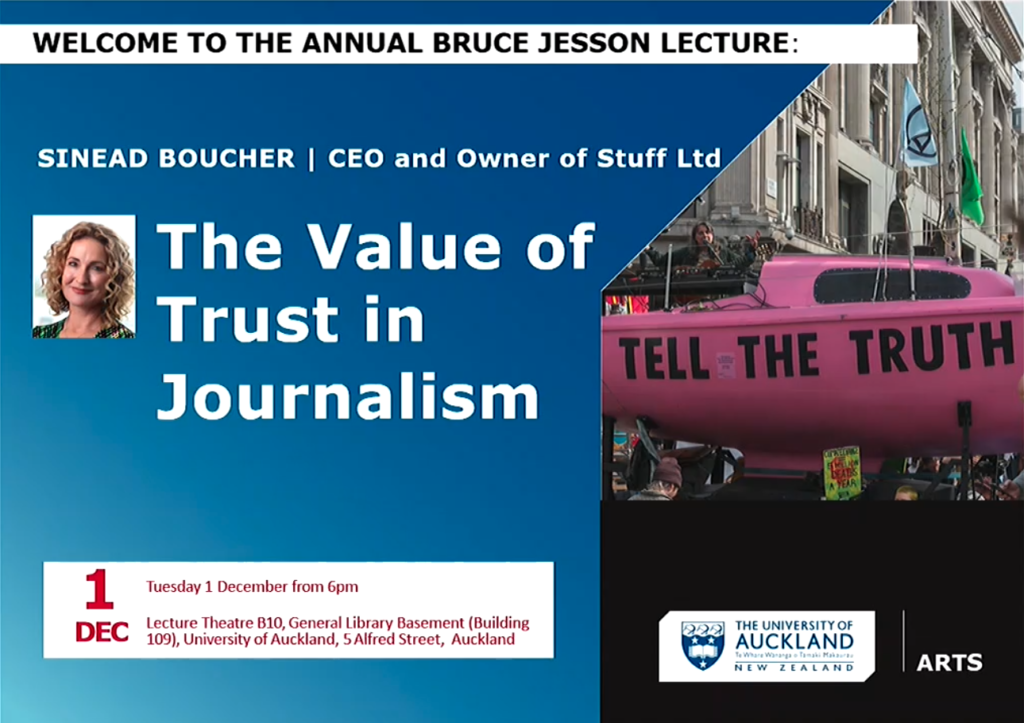
Sinead Boucher, the journalist who bought Stuff, New Zealand’s biggest media company1, for $1 will deliver this year’s Bruce Jesson Memorial Lecture.
Quality journalism has long sat at the heart of the democratic process – with a commitment to uncover the facts, and hold the powerful to account. Yet in a society increasingly plagued by misinformation and conspiracy theories, public trust in news organisations is under threat like never before.
In the wake of the US and NZ elections, this lecture will explore the importance of public trust in journalism. What can news organisations be doing to rebuild public trust? Is it possible in a world where social media platforms continue to grow, unchecked, fuelling greater division and social unrest? And, as the media landscape continues to undergo rapid and significant change, what learnings can the Stuff experience offer for those seeking to build a sustainable future for journalism, and find innovative ways to fund it?
Sinead Boucher was appointed Chief Executive Officer of Stuff in August 2017 and in 2020 completed a management buyout from Nine Entertainment Ltd, famously for a dollar. Prior to becoming CEO, Sinead was NZ Group Executive Editor for four years, responsible for NZ’s largest newsroom, a stable of newspapers and magazines, and the Stuff website. She started her career as a reporter for The Press in Christchurch and was a journalist at the Financial Times and Reuters in London before returning to New Zealand, where she became Stuff’s first digital editor. Under her watch, Stuff has grown to record audience numbers driven by the organisation’s reputation for award-winning journalism.
She will deliver the 2020 Bruce Jesson Lecture in Lecture Theatre B10, General Library Basement (Building 109), 5 Alfred Street, Auckland, at 6pm on Tuesday 1st December.
The lecture is free and open to all, but registration is encouraged. A collection will be taken to sustain the Bruce Jesson Foundation.
The Bruce Jesson Foundation is offering up to $4000 this year to fund a piece of critical journalism that will contribute to serious public debate in an era of “fake news” and up to $1500 for its Emerging Journalism Prize to recognise outstanding recent work. The increased value of this prize is possible thanks to the support of a gift from the Grace Memorial Trust in memory of Diana Unwin.
The Foundation’s annual grants aim to fund “critical, informed, analytical and creative journalism or writing which will contribute to public debate in New Zealand on an important issue or issues”.
Acting chair Simon Collins said applications for this year’s grant are now open, and close on Monday 14th September.
“Unlike other journalism awards, ours aim to pay upfront for journalism that would not be done otherwise,” he said.
“We are willing to pay for travel and other research costs, and for the time someone will need to produce a piece of serious journalism which is not ‘fake news’.
“Social media and the internet have made it possible for anyone in the world to produce journalism that contributes to public debate, but most people need to earn a living and don’t have the time to produce journalism that will uncover new facts or to do the research necessary to present a new, in-depth perspective on an important issue.
“We are not looking just for paid, professional journalists, because they are already paid to produce well-researched journalism.
“Rather, we are looking especially for people like Bruce Jesson, who produced critical books and articles analysing NZ society from the margins, driven by his passion to understand the world and to change it.”
Previous grants have part-funded books on inequality, on New Zealand’s role in the US “war on terror”, and on the abdication of corporate and political responsibility that led to the deaths of 29 miners at Pike River.
They have helped to finance Jon Stephenson’s award-winning reporting from Iraq, a documentary on New Zealand’s climate change policies, investigative articles on rest homes, and a report on how the welfare system treats beneficiaries in domestic relationships.
The foundation is also calling for nominations from tutors in NZ journalism courses for the $1500 Emerging Journalism Prize for “outstanding recent work by New Zealand print journalism students”.
This work must have been published, in any form, between the closing date for last year’s awards, 31 October 2019, and this year’s closing date, 14 September 2020.
Applications and nominations can be submitted online through the Foundation website or to the Secretary, Bruce Jesson Foundation, c/- Politics & International Relations, University of Auckland, Private Bag 92019, Auckland 1142
University of Auckland, October 22, 2019
Introduction
It is a real privilege to present this years Bruce Jesson memorial lecture.
I was lucky enough to meet Bruce and Joce Jesson when I was studying the Alliance as a postgraduate student. Bruce and Joce literally opened their home to me and provided me with a vast treasure trove of information about the Alliance and the history of progressive politics in New Zealand. And coming as I was from Australia it was an invaluable insiders’ perspective. In addition Bruce’s books and many articles over the years provided not only an important historical record but a theoretical conversation which is often lacking.
Entries for this year’s Bruce Jesson Journalism Awards will close on 31 October 2019.
The awards include a senior award paying up-front costs of up to $4000 for a planned work of “critical, informed, analytical and creative journalism or writing which will contribute to public debate in New Zealand on an important issue or issues”.
There is also an award of up to $1000 for published work by a New Zealand journalism student nominated by a journalism progrannme leader. This work must also be “critical, informed, analytical and creative journalism or writing which will contribute to public debate in New Zealand on an important issue or issues”.
Full criteria and details on how to apply are available on the Bruce Jesson Foundation website www.brucejesson.com.
Contacts:
Simon Collins, acting chair: 021 901 036, ehlarandsimon@gmail.com
Dr Geoff Kemp, trustee: 021 445 721, g.kemp@auckland.ac.nz
The former Green Party co-leader, who labelled his successor James Shaw’s Zero Carbon Bill as “toothless” when it was released in May, has titled his lecture: “Will the Zero Carbon Act really cut emissions? What institutional change does a climate emergency demand?”
Greenpeace NZ executive director Russel Norman will outline what is really needed to cut carbon emissions when he gives this year’s Bruce Jesson Lecture on October 22.
The lecture comes after a dramatic week at the United Nations where 16-year-old Swedish student Greta Thunberg told world leaders: “How dare you pretend that this can be solved with just business as usual and some technical solutions?”
Continue reading Greenpeace leader: What we really need to cut emissionsThis housing crisis is not a central or local government issue to resolve in isolation, this crisis has been in the making for many years and it’s now going to take many years of courageous and creative solutions backed by strategic planning and financial backing.
Bernie Smith, CEO of the Monte Cecilia Housing Trust, canvassed the situation in the 2018 Bruce Jesson Memorial Lecture and argued that we can do much more.
Click on the picture below to see a video of Bernie’s talk. The accompanying text and slides can be found here.
Frontline social housing worker Bernie Smith will examine how to restore secure housing for all New Zealanders in this year’s Bruce Jesson Memorial Lecture on October 23.
You can register here
Smith, the chief executive of Māngere-based Monte Cecilia Housing Trust, will argue that the Labour-led government is not doing enough to meet the housing needs of low-income families, and seems to be putting all its efforts into KiwiBuild houses that will cost up to $650,000 each.
“Why does the government believe it can solve the housing crisis by itself using the KiwiBuild programme, instead of proactively and creatively working with community housing providers to reduce the increasing gap between homelessness and home ownership?” Smith will ask.
“The government position is creating further poverty and a greater sense of hopelessness among New Zealand families, who only seek a warm, dry, affordable, long-term, sustainable rental home in which to raise their children.”
In an address titled “Housing crisis: A smoking gun with no silver bullet”, Smith will say that New Zealanders were initially excited by the new Labour-led government’s plans to tackle the crisis.
“But all we’ve ended up with is KiwiBuild,” he says.
“There is no silver bullet to solve the housing crisis, but this talk considers how together we might build strong healthy and safe communities and provide creative housing solutions for our people.
“Every man, women and child, once housed in a secure, warm, safe, affordable and sustainable home, can then stand tall in their culture, faith and gender, and only at that point can their dreams and aspirations begin to transpire and they become self-sufficient.”
With over 40 years in social services in New Zealand, Papua New Guinea and Australia, Smith has extensive experience of child protection and foster care, disabilities, seniors and now homelessness and poverty.
On returning to New Zealand in 2016, he was shocked to find that in South Auckland there were 100,000 people living in overcrowded and substandard housing, and appalled to see his own people living in garages, parks, cars and lodges.
He will deliver the 2018 Bruce Jesson Memorial Lecture in the Old Government House Lecture Theatre (102-G36) at the University of Auckland at 6pm on Tuesday 23 October.
About Monte Cecilia Housing Trust
Monte Cecilia Housing Trust was one of the first charities established to respond to the new phenomenon of homelessness in New Zealand in the 1980s. It was established by four other Catholic charities in 1982 and initially provided emergency housing in what is now called the Pah Homestead in Hillsborough Rd. The Church sold the Hillsborough site and moved the housing service to Māngere in 1982.
The trust now provides emergency housing for 40 families in South Auckland, 80 plus social housing in South & West Auckland, and provides social work support to homeless families in the Western Park motor camp at Rānui.
Wraparound services provided by Monte to support homeless families include: financial literacy, parenting programmes, household management, cooking classes, family goal setting and job seeking.
About the Bruce Jesson Memorial Lecture
The annual Bruce Jesson Memorial Lecture was established by the Bruce Jesson Foundation in 2000 to honour the journalist and politician Bruce Jesson, who died in 1999.
Jesson wrote and edited some of the most original, important and challenging journalism in New Zealand in The Republican, which he published on a hand-to-mouth basis from 1974 to 1995, as a columnist for Metro magazine, and in a series of books including The Fletcher Challenge: Wealth and Power in New Zealand (1980), Behind the Mirror Glass: The Growth of Wealth and Power in New Zealand in the Eighties (1987) andOnly Their Purpose is Mad: The Money Men Take Over New Zealand (1999).
He was elected to the Auckland Regional Council as an Alliance candidate in 1991 and chaired the Auckland Regional Services Trust from 1992 to 1995, keeping key assets such as the Auckland port in public ownership in the face of massive pressure by the National Government of the time to privatise them. He was also a research fellow in the Political Science Department at the University of Auckland, which co-sponsors the Jesson Lecture.
Past Bruce Jesson Lectures have been delivered by: David Lange (2000), Brian Easton (2001), Chris Trotter (2002), Jane Kelsey (2003), Ani Mikaere (2004), Colin James (2005), Gordon Campbell (2006), Laila Harre (2007), Mike Lee (2008), Robert Wade (2009), Annette Sykes (2010), Paul Dalziel (2011), Nicky Hager (2012), Ted Thomas (2013), Mike Joy (2014), Rod Oram (2015), Lisa Marriott (2016) and Tāmati Kruger (2017).